Contact Us
WV License: HI4563231-0621
VA License: 3380001852
Proudly Serving



When it comes to electrical safety, the Ground Fault Circuit Interrupter (GFCI) is arguably the most important device in your house. Whether it’s a specific outlet with “Test” and “Reset” buttons or a specialized breaker in your electrical panel, its sole job is to prevent you from becoming part of an electrical circuit.
Think of a GFCI as a highly sensitive “electrical scale.” It constantly monitors the balance of electricity flowing into a device and returning from it.
The Balance: Under normal conditions, the current going out (Hot) and coming back (Neutral) should be equal.
The Leak: If the GFCI senses a difference as small as 5 milliamps—about the amount of electricity it takes to light a tiny LED—it assumes electricity is “leaking” somewhere it shouldn’t be (like through a person into water or the ground).
The Reaction: The device “trips” and shuts off power in as little as 1/30th of a second.
This speed is critical. While cardiac arrest can occur if you are exposed to 30 milliamps for just a few seconds, a GFCI cuts the power before the current can reach that lethal threshold.
The impact of this technology is staggering. Before GFCI requirements became standard, approximately 800 people died annually from accidental electrocutions in the U.S. Today, that number has dropped to around 200.
GFCIs are required in “wet” or “damp” locations where the risk of a ground fault is highest:
Bathrooms and Kitchens (near sinks and countertops)
Garages and Basements
Outdoor Outlets
Laundry Areas
One of the most common points of confusion for homeowners is the “Code.” Many people believe that if their home was built in 1970, they only need to meet 1970 standards. However, safety doesn’t have a grandfather clause.
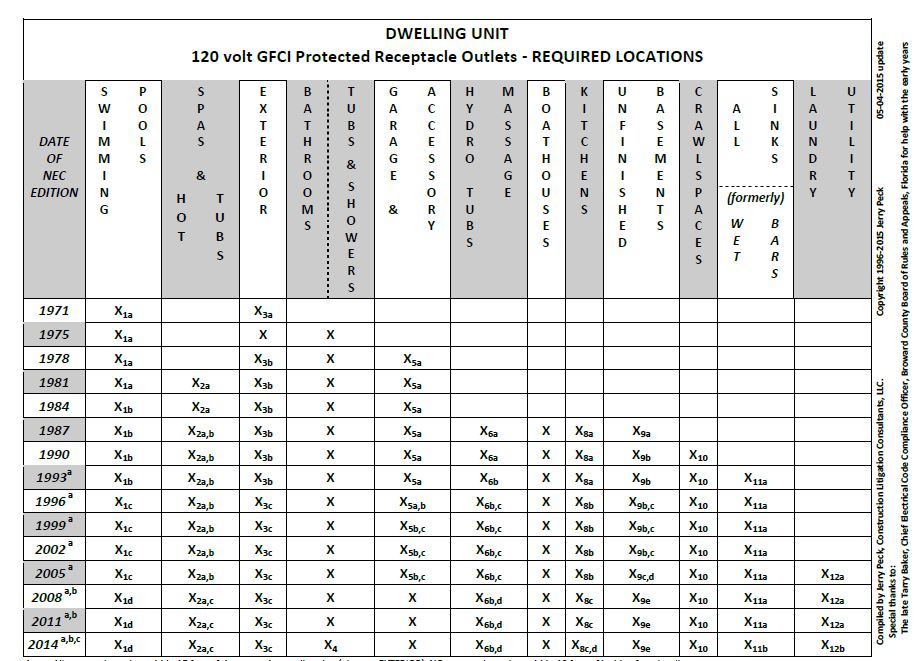
GFCI requirements have been added incrementally over the decades:
1973: Outdoor outlets required GFCI.
1975: Bathroom outlets required GFCI.
1978: Garage outlets added.
1987: Kitchen counters (within 6 feet of the sink) added.
Current Standards: Requirements now include crawl spaces, laundry rooms, and even dishwasher outlets.
As a Home Inspector, I evaluate your home by today’s safety standards. Even if your home was “to code” when it was built in 1980, it may be significantly less safe than a modern home. During an inspection, I test every accessible GFCI to ensure they trip and reset correctly, and I identify areas where protection is missing.
If your home inspection report notes a lack of GFCI protection, don’t panic—but do take action.
Note: While a real estate contract might not legally require a seller to bring an older home up to modern building codes, installing GFCIs is a low-cost, high-impact safety upgrade. Hiring a licensed electrician to swap out standard outlets for GFCIs in high-risk areas is one of the most affordable ways to protect your family from life-threatening electrical shocks.
| Year | Required Location |
| 1971 | Exterior (Pool equipment) |
| 1973 | All Exterior Outlets |
| 1975 | Bathrooms |
| 1978 | Garages |
| 1987 | Kitchen Countertops |
| 1990 | Unfinished Basements |
| 2005 | Laundry Rooms |
| 2014 | Dishwashers |
Does your home meet these safety milestones? A professional home inspection is the best way to find out exactly where you stand
My name is John de Saint Georges and I own The Inspection Company LLC. I have been living in West Virginia for the last 10 years and have loved every minute of it. From the New and Greenbrier rivers and Snowshoe Mountain, this state has it all. I hope I can help you look over your new home here in the mountain state. I will let you know everything that you may need to know about your new home
Whether it’s a 1000-square-foot loft, a rambling country estate, or 6000-square-foot commercial building, I won’t rest until you’ve received my easy-to-read report and all of your questions have been answered.
The Inspection Company uses the latest home inspection software to deliver you a visual, modern home inspection report that explains our findings in a way you can understand.